Excavations 2024


This is a temporary blog for presenting the excavations at Perdigões. Posts from 2011 to 2023 are available.

Thursday, 12 April 2018

0242 - Day 10 / Dia 10


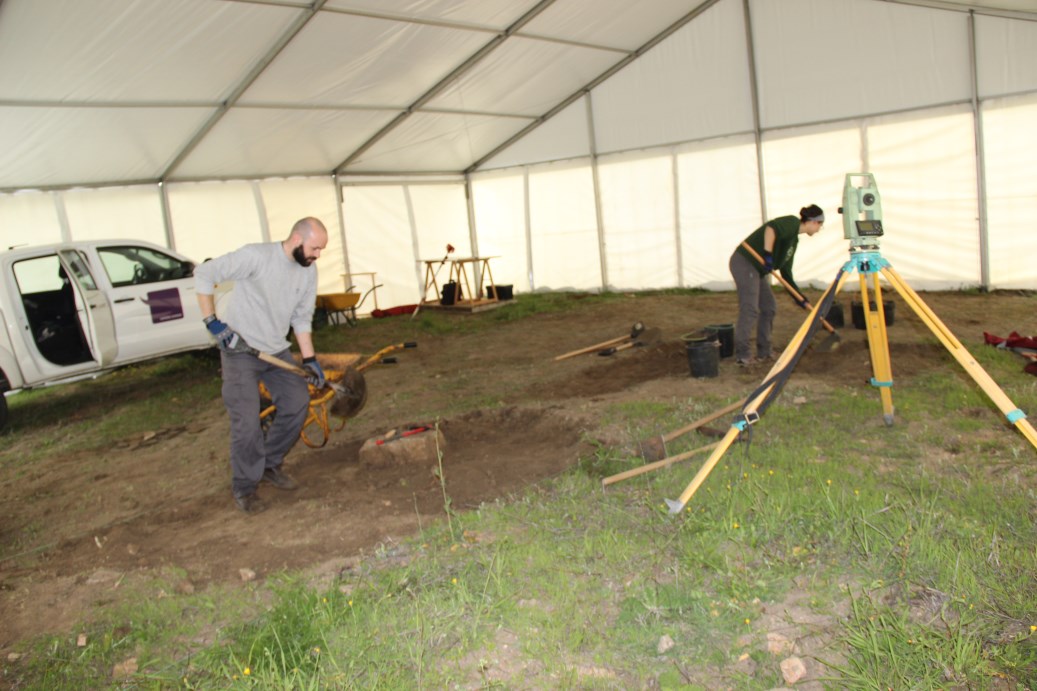
Enlarging the excavation to get all the chamber.
Alargando a escavação para abranger toda a câmara.


Defining the ploughing marks in the new area.
Definindo as marcas da surriba na nova área.


A visit in the afternoon from another Era team. A great help.
Uma visita à tarde de outra equipa da Era. Uma grande ajuda.


And the chamber is becoming more perceptible.
E a câmara começa a ficar mais perceptível.


And we start to understand the construction procedures: first a circular excavation of the bedrock, then a coating of clay and small stones, and finally a dry-stone wall of schist. Different from the other two tholos type structures already excavated at Perdigões
E começamos a perceber os procedimentos de construção: primeiro a escavação circular do geológico, depois um revestimento a argila com pequenas pedras, finalmente a parede de pedra seca em xisto. Diferente das duas outras estruturas tipo tholos excavadas nos Perdigões

Tuesday, 10 April 2018

0241 - Day 8 / Dia 8


Defining the preserved wall of the Tholos and a filling of clay and small stones between the schist wall and the bedrock cut.

Definindo a parede do Tholos e o preenchimento de argila e pequenas pedras entre a parede de xisto e o corte no geológico.


Defining the corridor.

Definindo o corredor.

Monday, 9 April 2018

0240 - Day 7 / Dia 7


Finally, getting to the preserved rows of the tholos Wall.

Finalmente a chegar às fiadas preservadas da parede do tholos.

Saturday, 7 April 2018

0239 - 6th day / 6º dia


This is how the ploughing dislocated and brought up part of the stone wall of the tholos type structure. The rows are at least seven, and the bottom stones could already be in place, although partially broken. This is giving hope that the structure may be preserved at the base. The rarity of materials continues, but human skull fragments and some teeth seam to confirm we are in presence of a funerary structure.
The stones of schist are not local and had to be brought from outside. The nearest schist is 5km away, but we want to determine with more precision the provenance of these stones. And also of the schist slabs of Tombs 1 and 2, already excavated. They are different kinds of schist.  Since we have been determining the strontium (Sr) values for several schist areas around the Ribeira do Álamo valley, we will try Sr to see if we can detect provenances. Work to be done in the context of the ongoing project on mobility of humans, animals, and objects at Perdigões.

É assim que a surriba desloca e tráz para cima uma parte da parede de pedras do sepulcro tipo tholos. As fiadas são pelo menos sete e as da base podem já estar in situ, ainda que parcialmente fragmentadas. O que nos trás a esperança da estrutura estar conservada ao nível da base. A raridade de materiais continua, mas alguns fragmentos de crânio e dentes humanos parecem confirmar que nos encontramos perante uma estrutura funerária.
As pedras de xisto não são locais e tiveram que ser trazidas para o sítio. A área mais próxima com xistos fica a 5Km dos Perdigões, mas queremos determinar com mais exactidão a proveniência destas pedras de xisto. E também das dos sepulcros 1 e 2, já escavados. São diferentes tipos de xisto. Uma vez que temos vindo a determinar os valores de estrôncio (Sr) para áreas xistosas em torno ao vale da ribeira do Álamo, vamos tentar detectar as proveniências através do Sr. Trabalho a realizar no âmbito do projecto em curso sobre a mobilidade de pessoas, animais e objectos nos Perdigões.

Friday, 6 April 2018

0238 - 5th day / Quinto dia


This is the image of how a deep ploughing can affect an archaeological structure, in this case a tholos. Nevertheless, we are starting to get an image of the structure between the ploughing trenches: a glimpse of the eastern limits of the walls of the circular chamber and of the alignment of the entrance corridor. Some indicators suggest that, at the base, we might get all the structure preserved.
A side, today we had tourists that came from Lisbon to specifically visit Perdigões and Esporão.

Esta é a imagem de como uma lavra profunda afecta uma estrutura arqueológica, neste caso um Tholos. Contudo, começamos a ter uma noção da estrutura entre as valas da surriba: a perspectiva dos limites Este da câmara circular e do alinhamento do corredor de acesso. Alguns indicadores sugerem que, ao nível da base, poderemos ter toda a estrutura preservada.
À parte, hoje tivemos a visita de alguns turistas vindos de Lisboa especificamente para visitar os Perdigões e o Esporão.


Wednesday, 4 April 2018

0237 - Day 3 / Dia 3


We are continuing to try to understand the damage caused by the ploughing and defining the preserved parts of the structure. Very few archaeological materials and bones are appearing. That could be a good sign with this degree of disturbance: maybe the structure is deep and the ploughing didn’t reach the main funerary deposits. But, today, a few teeth appear in the mixed deposits.

Continuamos a tentar entender a afectação provocada pela surriba e a definir as partes preservadas da estrutura. Muito pouco material arqueológico e ossos têm sido recolhidos. Isso pode ser um bom sinal, em face do grau de afectação: talvez a estrutura seja funda e a surriba não tenha atingido os principais depósitos funerários. Mas hoje apareceram alguns dentes nos depósitos revolvidos.

Tuesday, 3 April 2018

0236 - First evidences / Primeiras evidências


We have now 1,5 days of excavation, and the first evidences of structures are starting to appear. As expected, they are affected by the ploughing of 1996.
But it seems they are dry stone structure made of schist. So, it’s not a dolmen, but probably a tholoi. We’ll see. Some human bones, very small and fragmented, have already appeared.

Temos agora 1,5 dias de escavação e as primeiras evidências de estruturas estão a começar a aparecer. Como esperado, estão afectadas pela surriba de 1996.
Mas parecem ser em pedra seca com recurso ao xisto. Assim, não será um dólmen, mas possivelmente um tholoi. Veremos. Alguns ossos humanos, pequenos e muito fragmentados, já apareceram.


Monday, 2 April 2018

0235 - All set / Tudo a postos

A "house" with a garage and excavation started.

Uma "casa" com garagem e escavação iniciada.


Sunday, 1 April 2018

0234 - Improving the image / Melhorando a imagem

Sharpening the later image 

Before starting he excavation tomorrow, the later geophysics image was a bit improved (sharped). It seems we have a complex structure to deal with.

Antes de começar amanhã a escavação, a última imagem proporcionada pela geofísica foi um pouco melhorada em termos de contraste. Parece que temos uma estrutura bastante complexa pela frente.

Friday, 30 March 2018

O233 - Back in Easter / De volta na Páscoa


This year we start the campaign earlier, just after Easter. From April 2, and during six weeks, you may follow here the excavations of Era at Perdigões. We will start excavating Tomb 4.

Este ano começamos a campanha mais cedo, logo a seguir à Páscoa. A partir de 2 de Abril, poderá seguir aqui as escavações da Era nos Perdigões. Vamos começar a escavar o Sepulcro 4.

Sunday, 5 November 2017

0232 - Evidences of feasting?

Some of the several parts of limbs from sheep/goat of Pit 50, some from young animals.


Saturday, 4 November 2017

0231 - A weekend in the pit

Sounds much better in English.


Friday, 3 November 2017

0230 - Almost at the end

Perdigões this afternoon:


And the rainbow over the post that marks the NE gate. Humm...


Getting to the bottom. And another limb (obviously in the section).


Thursday, 2 November 2017

0229 - Getting deeper

Pit 50 is getting deeper and larger. Parts of limbs of goat/sheep in anatomical connection continue to appear, now with some bigger pottery shards.


Wednesday, 1 November 2017

Tuesday, 31 October 2017

0227 - Back for Pit 50

This week we returned to Perdigões to continue (and hopefully finishing) the excavation of Pit 50.


After a thick layer, a depositions of faunal remains, namely with several limb bones of goat/sheep, some in anatomical connection.


Thursday, 10 August 2017

0226 - Post Scriptum – A last minute visit

After the end of this year campaign and at his request, António Guterres, presently Secretary General of United Nations Organization, and family visited Perdigões enclosure, where they took notice of the main aspects of the Perdigões Research Program and of the site’s characteristics and its significant relation to the megalithic landscape of Reguengos de Monsaraz.


At the Museum, the process of discovery and the results of the first years of research were appreciated.


And the visit to the deposit, where José Roquette joined the rest of the group, allowed the contact with the discoveries of the last years of research, not yet expressed at the museum, and the explanations of Ricardo Godinho, that is studying the cremated human remains there.


Away from the cameras, a genuine interest in History and cultural heritage. A good reason to me for a quick leap to Perdigões. 

Saturday, 29 July 2017

0225 - The last (and long) post of the campaign


The team of the 2nd phase. Two are missing, one possibly trying to get out of pit 80 and the other wondering around with a machine in hands.


An example of the complexity of middle Neolithic ditches, suggesting the periodic building of ditched enclosures in the same general area.


An example of the cutting of a middle Neolithic ditch by a late Neolithic one (ditch 5). 


The end of ditch 5 under Chalcolithic deposits and structures. Possibly a gate.


Two sections of Chalcolithic circular structures dismounted during the Chalcolithic. A deposit separate them, and another deposit is under the lower one.


That last deposit is against  the face of the wall. This is showing a sequence of construction of these stone structures during the Chalcolirhic.


Pit 80 is getting deeper. Who knows me knows I am a Beatles fan. And this pit reminds me of a song from Pepper's: "It's getting better all the time", where Lennon sang in the back: "it can get no worse"


And finally, the column has already about 70 cm.

See you next year (if not before).

Friday, 28 July 2017

0224 - A general image...

... of the complexity of the central area of Perdigões. Structures dating from 3500 to 2000 BC.


The density of structures, cutting or overlapping each other, makes the excavation quite difficult and shows that these complex contexts can only be address in open area. And the ditches, namely the earlier ones, rarely go where we expect them to go.

Also interesting to see that the chalcolithic occupations don't just build and occupy  over the Neolithic ones. They cut the previous ones, and then form deposits and build. Something that was also detected in an area just some 10/15 meters to south of the right limits of this photo.